On-site improvement projects I worked on: signage, the bistro, seasonal installations, a winter chalet, and light shows.
La Grande Roue de Montréal · Partnerships
Rebuild trust. Create a partner platform.
- Role
- Partnerships, events and brand operations
- Period
- 2023–2024
- Business context
- Public landmark under trust scrutiny
- Remit
- Rebuild confidence and create a partner offer
- Decisions
- Visible care, packaged activations, shared intake
- What changed
- Partner platform and steadier delivery
- Evidence status
- Public validators + sanitized artefacts
La Grande Roue is the 60-metre observation wheel in Montreal's Old Port — a city landmark that lives on public trust. When I joined, a serious on-site incident had put the venue under safety scrutiny and local criticism. My mandate ran in three beats — rebuild confidence through visible professional care, build a partner offer that brands, institutions, and tourism players could actually buy, and turn one-off events into a repeatable activation engine across ticketing, content, and suppliers.
The numbers
What the rebuild delivered.
Turnout at each large public event once the programming rhythm was running.
The scale of the public-site recovery and activation programme; business context, not revenue attributed to me.
Suppliers and partners coordinated across programming, visitor experience and public activations.
Attendee-scale public moments supported through venue, partner and supplier coordination.
Ticketing automation and a standardized activation intake made coordination more consistent across 20+ suppliers.
The situation
A landmark that people had stopped trusting.
A serious on-site trust crisis is one of the hardest starting points a public venue can have. The wheel was still standing in the middle of the Old Port — visible from everywhere, photographed daily — but the story around it had turned to safety concerns and local criticism. A place like that cannot rebuild quietly: every visitor, journalist, and city stakeholder watches it in real time.
The venue also had a commercial problem underneath the reputational one. Partners will not attach their brand to a site under scrutiny, and events cannot scale when every activation is improvised from scratch. So the work had to run on two tracks at once: restore confidence in public, and build the operating machinery — intake, ticketing, suppliers, content — that would make the recovery repeatable rather than a one-season effort.
What I did
From damaged trust to a running activation engine, in five moves.
01 · Confidence
Make professional care visible.
The first job was credibility, not campaigns. The site had to look alive and responsibly operated again: active communication with safety sensitivity, better moments on-site, and a calmer relationship with the city around it. That meant showing the operational reality — maintenance, upkeep, the people who run the wheel — instead of hiding from the story. The ~$500K of site improvements I worked on carried the same message: signage, the bistro, seasonal installations, the winter chalet, and light shows all told visitors the place was moving forward.
02 · Partner offer
Package the wheel into something brands and institutions could buy.
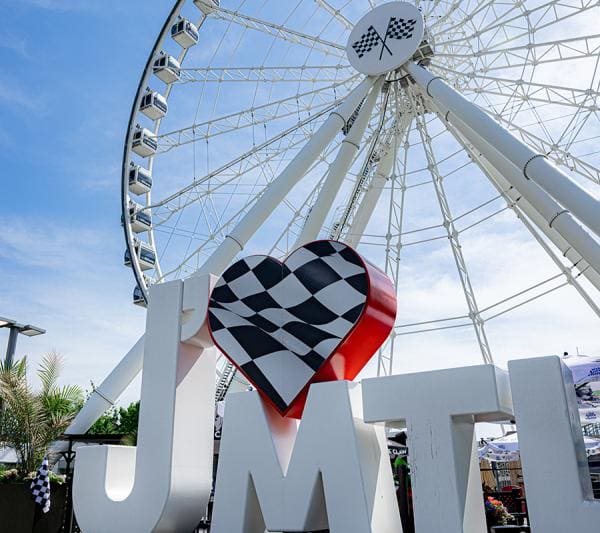
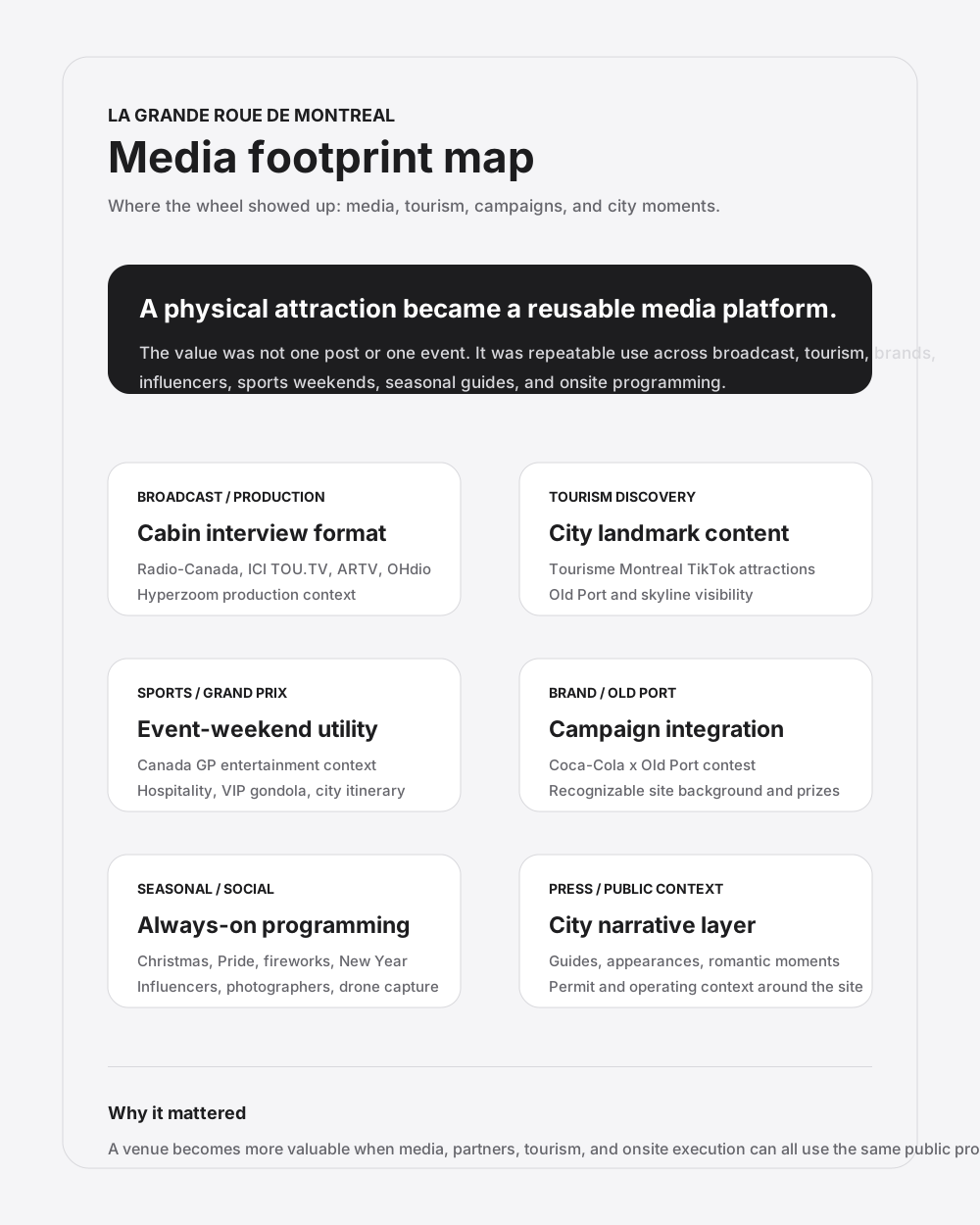
A recovering venue needs partners, and partners need a clear offer. I packaged the physical place into stories they could purchase: destination discovery, hospitality, brand visibility, social content, and city relevance. The partner roster ran from Coca-Cola and LEGO to Formula 1 Grand Prix weekend, alongside tourism-platform features and Old Port campaigns — making the attraction easy for other brands to use without losing operational control on-site.
03 · Activation engine
Standardize how an event gets from idea to results.
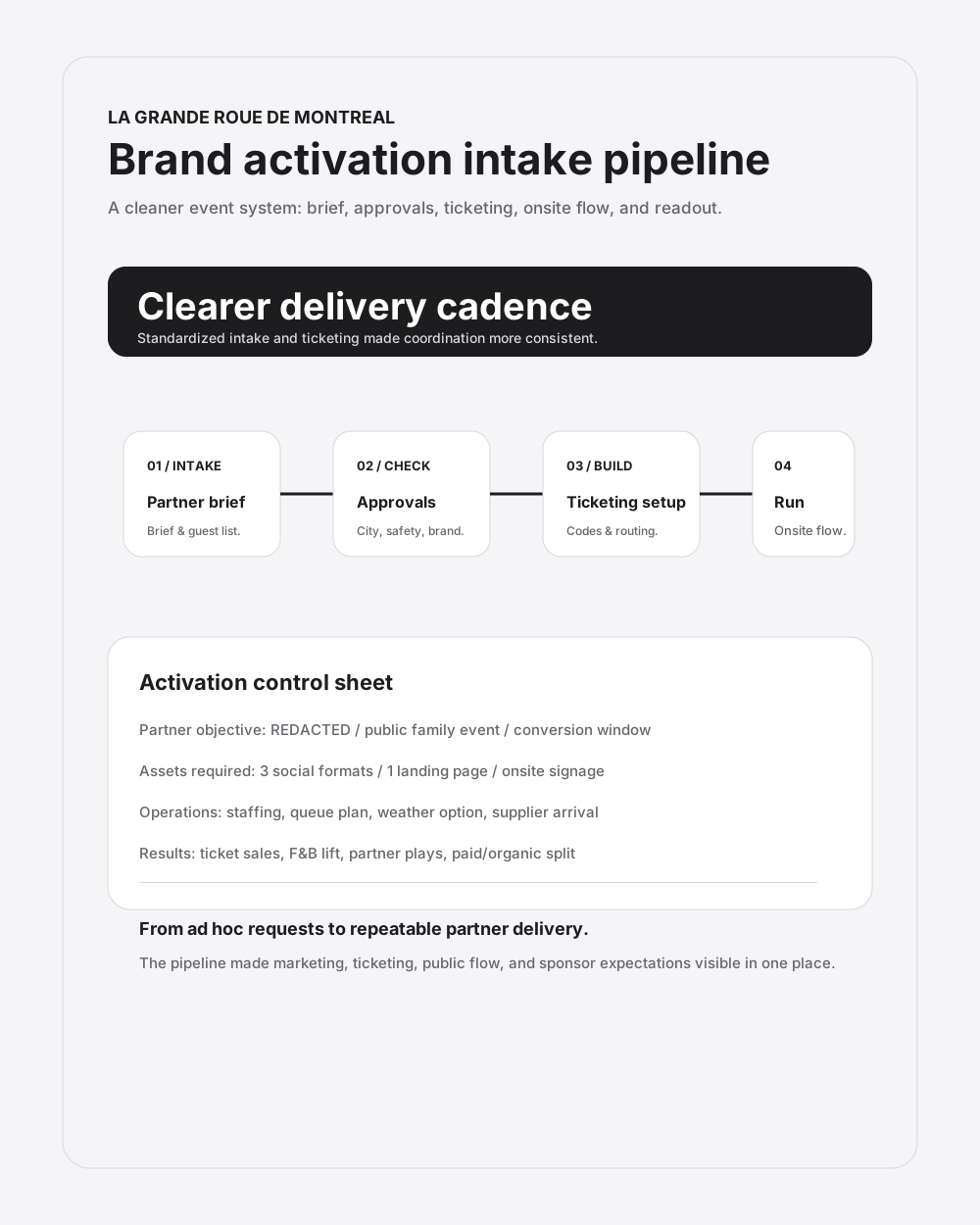
A destination event only lands when timings, approvals, physical setup, ticketing, content capture, and visitor flow arrive together. I coordinated 20+ suppliers and built a standardized activation intake — partner brief, approvals, ticketing setup, on-site flow, results readout — then paired it with ticketing automation to make delivery more consistent. IAAPA, the amusement-industry trade show, was part of this engine as industry research: best practices, innovations, and partner meetings brought straight back to the site.
04 · Seasonal rhythm
Give people a recurring reason to visit, photograph, and share.
Recovery sticks when the venue keeps producing moments worth showing up for. I ran a recurring programming rhythm — fireworks nights, New Year's Eve, Valentine's Day, holiday events — with the content work to match: photography, drone capture, editing, and influencer and photographer partnerships. Large public events drew 1,000+ attendees each, and each one fed the next season's content.
05 · Christmas campaign
Connect the plan, the creative, and the results in one view.
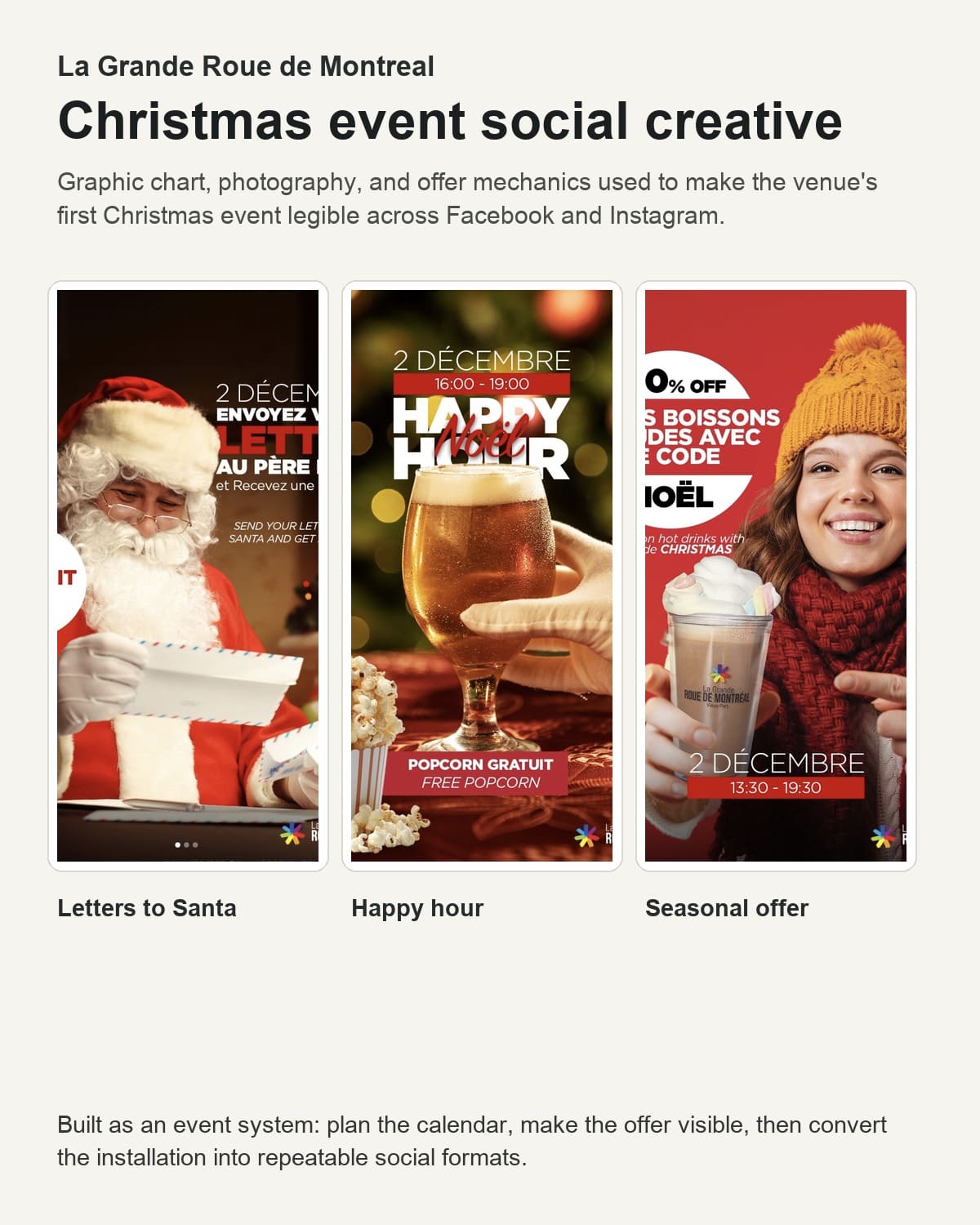
The seasonal programme showed that the engine could work end to end: a calendar, bilingual offers, repeatable Facebook and Instagram formats, partner distribution, supplier coordination and an operational readout connecting ticketing, food-and-beverage and media activity. Exact commercial comparisons remain off the public site; the public-safe proof is the reusable campaign and delivery system.
What it changed
A venue that partners came back to.
- The public story shifted from safety scrutiny to visible professional care — maintenance, site improvements, and active programming that people could see for themselves.
- Brands, institutions, and tourism platforms had a packaged offer to buy instead of a case-by-case negotiation, from Grand Prix decoration to Old Port campaigns.
- Bilingual seasonal formats gave the venue and its partners reusable campaign material instead of one-off execution.
- Standardized intake and ticketing workflows gave the next season a repeatable process instead of restarting from improvisation.
- The activation logic — intake, supplier coordination, content rhythm, results reporting — stayed with the team as a repeatable system after my mandate ended.
Direct reference
In their own words.
“Henrique’s ability to build meaningful partnerships with organizations and global brands was pivotal to this transformation.”
Proof you can check
Public traces of the work.
Where this transfers
What this chapter proves beyond one attraction.
- Reputation recovery
- Partnership packaging
- Event operations
- Ticketing & process automation
- Supplier coordination
- Destination content
Hiring next step
See how this work fits your brief.
The hiring brief shows where this experience creates the most value, with the boundaries and evidence useful to your decision.