Crew, actors, and extras who joined the shoot on trust in the project and the organization behind it.
Kingston Films · Production
Make a film through coordination, not budget.
- Role
- Treasurer and production coordinator
- Period
- 2015–2017
- Business context
- Volunteer short film with almost no budget
- Remit
- Castings, permissions, funds and on-site support
- Decisions
- Formal roles, honest expectations and town coordination
- Verified outcome
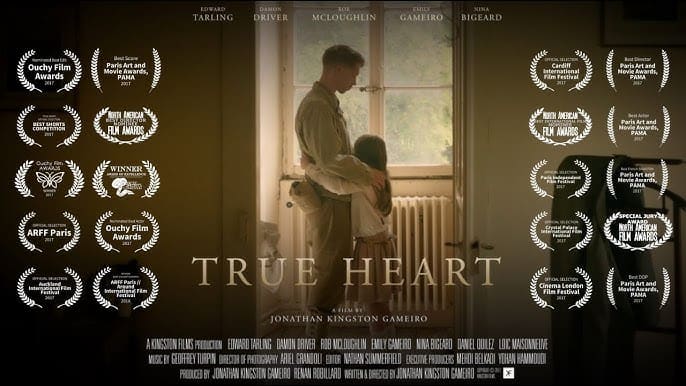
- 5 awards · 17 nominations · 145K+ public views
- Evidence status
- Public film/poster + formal source records
Before any of the corporate chapters, there was Kingston Films: a production company I organized with close high-school collaborators. Jonathan was president, I was treasurer, and when he and Renan wrote and directed the short film True Heart, my job was everything around the camera — castings, negotiating with the town of Sixt-Fer-à-Cheval, traffic, extras, funds, and on-site coordination. It is the earliest chapter here, and the first time I learned to organize people and logistics until a project actually happened.
The numbers
What a volunteer production delivered.
I travelled back during my studies to help run the production on site.
Across festivals in the US, France, Switzerland, the UK, Wales, and New Zealand.
What the full short film has reached on YouTube since its public release.
The story
A film made possible by organization, not money.
Kingston Films started as a group of high-school friends deciding to make films seriously — a self-organized production company with real roles instead of a loose collective. Jonathan was president and I was treasurer. When he and Renan wrote and directed True Heart, the ambition immediately outgrew the resources: a period short film with professional expectations and almost no budget.
My contribution was the production layer that let the film exist. I helped run castings, negotiated permissions with the town of Sixt-Fer-à-Cheval, managed traffic around the locations, recruited and looked after extras, watched the funds, and coordinated the days on site. By the time the shoot came, I was studying in Canada, so I travelled back to help run the production on the ground.
This chapter is early and small next to the rest of my work, and I present it that way. What it shows is simple: before anyone paid me to coordinate anything, I could help a town and a large unpaid team of crew, actors, and extras mobilize around a project with almost no budget and carry it through to completion. The film went on to win 5 awards and collect 17 nominations on the international festival circuit.
What I did
Build the structure, gather the people, run the shoot.
01 · Company setup
Make the project serious enough to join.
Kingston Films began as a self-organized production structure, and the early work was purely operational: roles, responsibilities, coordination, and credibility. As treasurer I handled the funds, but the real task was making a group of teenagers look — and function — like a production company that actors, crew, local stakeholders, and extras could take seriously.
02 · Casting and crew
Convince professionals to work for belief, not pay.
The production needed actors, technical crew, and extras — and none of the usual financial conditions were on the table. My role was to make people comfortable enough to contribute anyway: clear castings, honest expectations, and enough visible organization that giving serious work to a small project felt safe rather than naive.
03 · The shoot and after
Run the location, then help the film travel.
Shooting in Sixt-Fer-à-Cheval meant coordinating with the town itself: permissions, traffic, local stakeholders, extras, timing, comfort, and continuity — the field layer I flew back from Canada to help run. After the shoot, the work continued through festival submissions and public presentation. The film's public record shows 5 awards, 17 nominations, and 145K+ YouTube views; those outcomes belong to the full team.
Proof you can check
The film is public — you can watch it.
Recognition
Five awards, seventeen nominations.
True Heart travelled the international festival circuit — the US, France, Switzerland, the UK, Wales, and New Zealand.
5 Awards
- ★Best Shorts Competition — Award of Excellence, Best International Short FilmSan Diego, USA
- ★Ouchy Film Awards — Best Edit (Yearly)Lausanne, Switzerland
- ★Ouchy Film Awards — Best Edit (Trimester)Lausanne, Switzerland
- ★ARFF International Paris — Best CinematographyParis, France
- ★North American Film Awards — Special Jury AwardUSA
17 Nominations & selections
- ◆Best Shorts Competition — Official SelectionSan Diego, USA
- ◆Paris Art and Movie Awards — Best French Short FilmParis, France
- ◆Paris Art and Movie Awards — Best DirectorParis, France
- ◆Paris Art and Movie Awards — Best CinematographyParis, France
- ◆Paris Art and Movie Awards — Best ActorParis, France
- ◆Paris Art and Movie Awards — Best Music ScoreParis, France
- ◆Auckland International Film Festival — Official SelectionAuckland, New Zealand
- ◆Ouchy Film Awards — Best ActorLausanne, Switzerland
- ◆Ouchy Film Awards — Best EditLausanne, Switzerland
- ◆Ouchy Film Awards — Best Edit (Yearly)Lausanne, Switzerland
- ◆ARFF International Paris — Best CinematographyParis, France
- ◆Cinema London Festival — Best FilmLondon, UK
- ◆Cardiff International Film Festival — Best FilmCardiff, Wales
- ◆Crystal Palace International Film Festival — Official SelectionLondon, UK
- ◆North American Film Awards — Best International FilmUSA
- ◆North American Film Awards — Best DirectorUSA
- ◆Paris Independent Film Festival — Official SelectionParis, France
Where this transfers
What this chapter proves beyond film.
- Production coordination
- Stakeholder negotiation
- Budget stewardship
- Constraint management
- Team trust
- Field logistics
Hiring next step
See how this work fits your brief.
The hiring brief shows where this experience creates the most value, with the boundaries and evidence useful to your decision.